Mountain Gorillas in 2026: One of Conservation’s Few Real Wins

Photo: Unsplash (free-use license).
The mountain gorilla is the rarest of the great apes, the most political, and — almost uniquely in modern conservation — the one with a population trend pointing the right way. Below: where the species actually stands in 2026, why it has recovered when most large mammals haven’t, and the unglamorous reasons it could still go backwards.
The number, and where it sits
The most recent census, published from the Greater Virunga Trans-boundary Collaboration in late 2024, puts the global population of mountain gorillas (Gorilla beringei beringei) at around 1,063 individuals. They live in two completely separated populations:
- The Virunga Massif — a chain of forested volcanoes spanning the borders of Rwanda, Uganda, and the Democratic Republic of the Congo. Around 604 individuals at the latest count.
- Bwindi Impenetrable Forest — a single national park in southwestern Uganda, plus the contiguous Sarambwe Reserve in DRC. Around 459 individuals.
That’s it. The entire species. The whole global range fits inside a region you could drive across in a long day, if there were drivable roads through the forest, which there are not.
For context: in 1981, Dian Fossey’s surveys put the Virunga population at around 254 animals. In the late 1980s, after a brutal poaching wave, it dropped further — credible counts went under 250. The fact that the same population is now over 600, after thirty years of work, is one of the more remarkable conservation outcomes of the modern era.
Why mountain gorillas are recovering when others aren’t
You can summarise it in three words: tourism, enforcement, partnership. None of those are surprising. The combination, sustained for thirty-plus years, is what’s surprising.
Tourism with a price tag
Rwanda charges $1,500 for a single one-hour gorilla trek permit; Uganda is around $800; DRC’s Virunga National Park is cheaper but has had repeated security closures. That high price is the single most-criticised feature of the programme — the optics of charging a Western tourist’s monthly mortgage for an hour with a gorilla family are obvious. The economics defend it: the permit revenue funds anti-poaching patrols, ranger salaries, veterinary intervention, and the local-community revenue-sharing that makes the trade-off legible to people who live near the forest. Take the high-priced permits away and the equation collapses inside a year.
Enforcement that actually works
The ranger force across Volcanoes National Park (Rwanda), Bwindi (Uganda), Mgahinga (Uganda), and Virunga (DRC) is large, well-trained, and — for the most part — well-paid by regional standards. Ranger fatalities in DRC have been tragically high; Virunga has lost more than 200 rangers since the park’s founding. The enforcement isn’t theatre. It’s a serious operation that has been the operative variable in the species’ recovery.
Cross-border collaboration
The Greater Virunga Trans-boundary Collaboration — Rwanda, Uganda, DRC — is a genuinely working three-government partnership, which is rare in any field. Joint patrols, shared veterinary protocols, coordinated census methodology. Most large-mammal recovery programmes have nothing equivalent. (Compare: the Amur leopard, split across Russia and China; the Saola, split across Vietnam and Laos. Neither has anything like this.)
What’s still going wrong
The forest itself
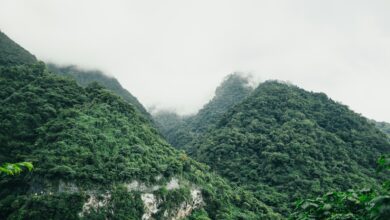
Mountain gorillas are squeezed into roughly 800 square kilometres of forest, total. There is no expansion possible — every park is bordered by intensively-cultivated farmland, and Rwanda is one of the most densely-populated countries on the African continent. The species is doing well in absolute terms but it is doing well in a finite container, and an outbreak of disease or a single severe-fire year could erase a decade of recovery.
Disease
Gorillas are close enough to humans, genetically, that they catch our colds. They also catch our scabies, our tuberculosis, our COVID-19. The 2020-2021 period produced documented SARS-CoV-2 cases in gorillas at multiple parks; the ranger and tracker corps was prioritised for vaccination at considerable speed, and the protocols around tourist proximity were tightened (mandatory N95 masks within 10 metres, distance increased from 7m to 10m). It worked. But the threat is structural, not episodic.
Conflict in eastern DRC
The Virunga side of the population sits inside one of the most geopolitically unstable regions in Africa. The 2023-2024 escalation around the M23 rebellion produced repeated park closures, displaced rangers, and re-introduced organised armed groups into corridors that had been clear for years. The Congolese sector of the Virunga population is the most operationally vulnerable subpopulation in the species and it is not a coincidence that the Rwandan and Ugandan sectors have grown faster.
Climate
The bamboo and herbaceous vegetation mountain gorillas eat is climate-sensitive. Bwindi has shown shifts in food-plant phenology over the last two decades. The species is at altitudes (2,200–4,300 m) where there is, simply, no higher to go. They are at the top of their mountain, biologically.
What about the other gorillas?
This is worth saying clearly because the public conversation tends to flatten it. There are two species of gorilla and four sub-species. The mountain gorilla is one sub-species of one species. The others are:
- Western lowland gorilla (Gorilla gorilla gorilla) — the species you’ll see in most zoos. Several hundred thousand wild individuals. Critically Endangered.
- Cross River gorilla (Gorilla gorilla diehli) — under 300 individuals, on the Nigeria/Cameroon border. The most endangered of all gorillas.
- Eastern lowland (Grauer’s) gorilla (Gorilla beringei graueri) — eastern DRC, around 6,800 individuals, declined sharply since the late 1990s. Critically Endangered.
- Mountain gorilla (Gorilla beringei beringei) — the species this piece is about. Endangered (downgraded from Critically Endangered in 2018).
So when somebody says “gorillas are recovering,” that is true of the mountain gorilla and only the mountain gorilla. The other three sub-species are doing worse, and the Cross River gorilla is closer to losing its species than gaining ground.
Going to see them
If you can afford the permit, you should go. The trek is one of the genuine wildlife experiences left on the planet, and the permit money is doing real work. A few practical notes from the team:
- Rwanda’s Volcanoes National Park is the most logistically straightforward starting point. Bwindi is cheaper and the forest is denser; the trek is harder but the experience is, by some accounts, better.
- Take the recommended cold-medicine prep seriously. If you have a respiratory infection on the day of your trek, do the responsible thing and reschedule. The gorillas can’t.
- The 60-minute encounter rule is enforced and exists for the gorillas’ sake, not the tourists’. Don’t push it.
- Tip the rangers and trackers. They are the operative variable.
Reading further
For more on great-ape conservation in the same region, see our coverage of Virunga and the African wild dog recovery. For the wider African wildlife archive, our African Wildlife section is the easiest entry point. Our cornerstone Endangered Species List 2026 places the mountain gorilla story in the broader 2026 context.
External: the IUCN Red List entry for Gorilla beringei beringei is the canonical status reference, and the Fauna & Flora International species page is one of the few NGO pages that updates as new census data lands.
If you’ve made the trek and have a story or a photograph you’d let us use, please say hello. We don’t get there as often as we’d like.
— Liam Trent, managing editor