The Grizzly Bear Expands Its Range

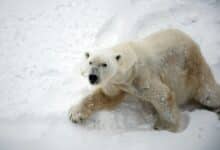
As The Arctic Warms, Grizzlies Push Into Polar Bear Habitat, Setting Up A Potential Conflict Between Species. Photo:Jean-Pierre Lavoie

Climate Change May Be Benefiting One Species To The Detriment Of Another

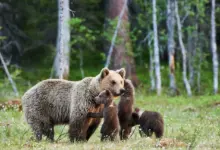
Wildlife researchers from the American Museum of Natural History report that grizzly bears have been appearing in Canadian sub-Arctic habitat that previously was the exclusive domain of polar bears. The research team, led by Dr. Robert Rockwell, documented the presence of grizzlies in northwest Manitoba’s Wapusk National Park, in the area of Hudson Bay.

The Town of Churchill, Manitoba, on Hudson Bay, is perhaps the world’s most popular spot for observing polar bears.

According to a report by Dr. Rockwell, which was published in the scientific journal Canadian Field-Naturalist, Wapusk National Park contains plentiful food resources for grizzlies, including berries, fish, caribou and moose. The report was careful not to attribute the grizzly’s northern expansion to any particular factor. However, wildlife researchers have previously predicted that climate-change-related warming of the Arctic and sub-Arctic tundras could create conditions favorable to a natural colonization by grizzly bears.

Polar bears, meanwhile, are struggling as a species due to a climate-change-related loss of habitat. The white bears hunt for prey such as seals on ocean ice—and that ice has become increasingly scarce due to rising temperatures in the northern oceans.

Habitat encroachment by grizzly bears could further harm polar bears through competition for food resources. In addition, Dr. Rockwell’s team reported some evidence to indicate that grizzlies may occasionally attack, kill and eat hibernating female polar bears and their young—and that polar bears may do the same to dormant grizzlies.

A further potential problem is the hybridization of polar bears and grizzly bears, which are closely related species. Polar bears are believed to have evolved from grizzlies during a glacial period about 300,000 years ago, and when the two species mate—which has occasionally occurred in the wild—they produce fertile young. Hybrid bears could complicate the survival of polar bears as a distinct species.

Read Dr. Rockwell’s original article.

{ 0 comments }

Alaska Launches A Public Relations War Against Polar Bears. Let’s Just Say NO!

It’s time to say NO TO ALASKA.

On February 4, a committee of the Alaska State Legislature approved a budget of $1.5 Million to launch a nation-wide public-relations war against polar bears and the US Endangered Species Act. Alaska’s government views polar bears as being an obstacle to oil and gas exploration and exploitation along the state’s Arctic coastline. Although federal protections recently extended to polar bears do not prohibit the development of natural resources in polar bear habitat, they do require permission for those activities.

But the Alaska legislature apparently would prefer that the oil companies’ lives not be made more complicated by concerns for polar bears and other wildlife. The state’s Legislative Council is currently shopping for just the right public relations firm to lead the charge against the bears and in favor of weakening the Endangered Species Act.

Polar bears were listed as “Threatened” under the Endangered Species Act in 2008 after the US Fish & Wildlife Service determined that climate change in the Arctic was severely reducing the amount of sea ice on which the bears hunt seals and other marine mammals.

In late 2009, the federal government proposed the designation of over 200,000 square miles of Alaskan land and water as “critical habitat” for polar bears. Some of this critical habitat also contains potential reserves of oil and natural gas.

The Endangered Species Act prohibits actions that adversely affect critical habitat for a listed species. Commercial activities within critical habitat are not banned, but they do require government regulation and oversight.

In announcing the critical habitat proposal, US Interior Department Assistant Secretary for Fish, Wildlife and Parks, Tom Strickland, said, “Proposing critical habitat for this iconic species is one step in the right direction to help this species stave off extinction, recognizing that the greatest threat to the polar bear is the melting of Arctic sea ice caused by climate change. As we move forward with a comprehensive energy and climate strategy, we will continue to work and protect the polar bear and its fragile environment.” [click to continue…]

{ 0 comments }

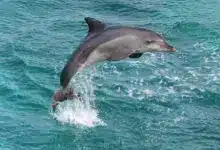
A dolphin-loving American consumer would have to look awfully hard these days to find a can of tuna that was not technically “dolphin safe.” In fact, less than 2 percent of of all canned tuna sold in the US is caught by chasing and intentionally netting combined groups of yellowfin tuna and dolphins. The bad news is that the main “dolphin-safe” fishing method is responsible for killing a lot of other sea life—as well as at least a few dolphins.

What Exactly Is Safe About it?

BY PAUL GUERNSEY

It has been a habit of mine for years: Whenever I buy a can of tuna in the supermarket, I conscientiously search the label for the “dolphin-safe” logo. Upon locating the emblemized image of the world’s most popular sea mammal and its accompanying handful of reassuring words, I invariably feel a little flash of relief followed by a brief glow of virtue. Then it’s on to the dressing aisle to get that jar of mayonnaise. . . .

Unfortunately, in the wake of some recent research into what the term “dolphin-safe” actually means, my enjoyment of a tuna sandwich—I like mine on rye, with lettuce and sliced Spanish olives—is now surrounded by a great deal more ambiguity than it used to be. This is not because I think the large, multi-national tuna fleet that operates off the western coasts of the Americas is still killing 130,000 dolphins every year the way it did before widespread public horror and a US consumer tuna boycott in the late 1980′s led to sweeping changes in the fishery. By all accounts, it’s not—although some dolphins do continue to suffer unintentional drownings in purse-seine fishing nets.

Rather, most of my reservations now have to do with the “dolphin-safe” part of the tuna industry. And while it is possible that fishermen using “dolphin-safe” methods off the coasts of western North and South America may be under-reporting the number of dolphins they kill—most “dolphin-safe” boats are too small to require observers aboard—it is not even primarily dolphins that I and many other conservationists are concerned about.

What bothers me—and should concern every environmentally conscious US consumer of canned tuna—is the tremendous number of fish, including sharks and other marine species, that are killed and discarded as “by-catch” by fishermen using the most widely employed “dolphin-safe” fishing technique—a collateral-damage problem that, ironically, the still-sizable contingent of non-dolphin-safe fishermen manages for the most part to avoid.

According to an estimate by the Environmental Justice Foundation, each dolphin spared by switching from “non-dolphin-safe” fishing techniques to the most widely employed alternative costs the lives of 25,824 small tuna (these are discarded, not kept and utilized), 27 sharks and rays, 382 mahi mahi (also known as “dolphin fish”), 188 wahoo, 82 yellowtail and other large fish, 1 billfish such as a marlin or sailfish and 1,193 triggerfish and other small fish.

Dr. Martin Hall, principal scientist for the Inter-American Tropical Tuna Commission (IATTC)—the regulatory body that oversees tuna fishing on the American side of the Pacific—offers estimates that, while still horrific, are somewhat lower, most notably, in the number of small tuna inadvertently killed per dolphin spared (15,620) as well as a smaller number of triggerfish and other small fish.

Of special concern to conservationists is the number of sharks caught as by-catch, because many species of these marine predators are under intense fishing pressure worldwide, and an increasing number of them have been appearing on the International Union for the Conservation of Nature (IUCN) Red List of Threatened Species.

US consumers have been purchasing tuna labeled as dolphin-safe since 1990. [click to continue…]

{ 1 comment }

SPECIES MOST ENDANGERED BY GLOBAL WARMING

by Editor on December 17, 2009

The Arctic Fox Is One Of Nine Animals the IUCN Says Is Threatened By Global Warming. Photo:USFWS

The Arctic Fox Is One Of Nine Animals the IUCN Says Is Threatened By Global Warming. Photo:USFWS

Global Climate Change Threatens A Host Of Animals Other Than Just Polar Bears

We have mentioned in other places on this site that the the world contains thousands of vulnerable, threatened and endangered species, and that lists of the “most threatened” animals often say as much about the people making the lists as they do about either the listed animals or the specific threats facing them. In other words, the makeup of the list depends on the message that a particular lister is trying to communicate to anyone who might read that list. The personal preferences, and even prejudices, of the lister might also play a role.

That’s not to say, however, that lists are not useful. In the last week, two conservation organizations have stepped forward with lists that they hope will serve to remind people that, while global climate change has been causing some much publicized problems for polar bears, there are a lot of other creatures as well that are likely to suffer because of global warming.

The two lists, not surprisingly, have very different animals on them. The Species and Climate Change list, published last week by the International Union for the Conservation of Nature (IUCN), profiles 9 animals, mostly from the Arctic but also from elsewhere, as well as one plant, in order to illustrate several of the many environmental problems that befall living things when their climate changes. The IUCN, by the way, is the international organization that maintains the complete lists of the world’s thousands of endangered, threatened and vulnerable species.

Meanwhile, the Wilderness Conservation Society last week published its own list of Species Facing the Heat as a way to draw attention to some “unsung” animals that are being threatened by global climate change.

The IUCN List Includes: [click to continue…]

{ 0 comments }

TOOL USE IN ANIMALS

by Editor on December 15, 2009

An Octopus Species Is The First Invertebrate Documented As One Of A Growing Number Of Animals That Use Tools. Photo:Nick Hobgood

An Octopus Species Is The First Invertebrate Documented As One Of A Growing Number Of Animals That Use Tools. Photo:Nick Hobgood

Octopus Carries And Uses Coconut-Shell “Armor;” Critically Endangered Gorillas Launch “Weapons” At People

It used to be that we humans believed tool use was one of the main things that separated us from the rest of the animals.

Then the famed chimpanzee researcher Dr. Jane Goodall came along in the 1960′s and documented tool use among chimpanzees: She witnessed chimps modifying tree branches and then poking them into termite mounds in order to harvest a snack of termites.

The shock of Dr. Goodall’s discovery soon faded, however, as humans discussed it and finally concluded that, since chimps are our closest animals relatives and actually quite a bit like us in many ways, tool use among them probably should not have taken us by such surprise. But of course, tool use among any other species would be extremely unlikely . . .

Since then, however, species after species has been revealed by animal behaviorists to be makers and users of tools—and, unlike chimps, some of them are very unlike us. For instance, crows and other birds have been proven to use sticks to manipulate food and other objects in their environment.

Meanwhile, some monkey species as well as all the other species of great apes aside from chimps have shown themselves to be tool users. Orangutans fashion rain hats and build shelters out of leaves, while gorillas have been witnessed using using sticks to test the depth of streams before crossing them. [click to continue…]

{ 0 comments }

AMERICAN BATS FACE FATAL DISEASE

by Editor on December 14, 2009

Bat Affected By Fatal Fungal Illness. Photo:USFWS

Bat Affected By Fatal Fungal Illness. Photo:USFWS

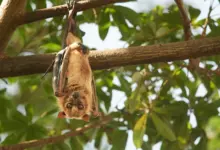
The US Fish and Wildlife Service (USFWS) plans to take steps this winter to prevent the spread of white-nose disease, a fatal fungal illness that strikes bats in the their hibernation caves in the eastern US. USFWS thinks people may be unwittingly spreading the illness.

Not To The Bat Cave

The US Fish & Wildlife Services thinks it’s best if people in the eastern US stay out of caves and mines where bats are hibernating this winter. A set of new rules proposed by the federal wildlife agency are not for the protection of people; they’re an attempt to keep thousands more bats from dying of a fast-spreading fatal disease.

A fungal illness called white-nose disease has killed hundreds of thousands of bats in the eastern US since it was first discovered in 2006. Bats that have succumbed to the disease include up to one-third of the Northeast’s population of Indiana bats, which are are listed as a US endangered species. White-nose disease is named for its most prominent symptom: A patch of white fungus that appears on the faces of hibernating bats that have been infected. Other symptoms include unusual behavior among the bats, including flying during daylight hours, flying during the winter when they are usually hibernating and when there are no insects available, roosting in the coldest parts of a cave, and excessive grooming.

There is no cure for the disease, and wildlife biologists are seeking ways to prevent it from spreading. Although bats are thought to contract white-nose disease from other bats, scientists are also concerned that the fungus may hitch a ride on humans who travel from an infected bat roost to an uninfected one.

As a precaution, USFWS is proposing to ban human access to many infected bat lairs, and to reduce access to many others.

White-nose disease first appeared in the Northeast, where it has devastated bat populations. It is now affecting bat colonies from New York, Vermont and New Hampshire south to Virginia, and has been spreading further toward the Southeast and to the Midwest.

{ 0 comments }

MONEY BELT HOLDS SMUGGLED SPECIES

by Editor on December 9, 2009

An Australian Gecko In Its Native Habitat. Photo:Calistemon

An Australian Gecko In Its Native Habitat. Photo:Calistemon

Federal authorities report that they arrested an arriving passenger at Los Angeles International Airport after they discovered that his clothing concealed a money belt in which he had allegedly stuffed 15 lizards from Australia, including two monitor lizards that are protected under the Convention on International Trade in Endangered Species (CITES).

The Smuggling Of Wild Birds And Animals For Sale In The Pet Trade Is A Form Of Poaching

A money belt found around the torso of a California man returning from Australia to the US via Los Angeles International Airport was allegedly packed with lizards from Down Under. According the the US Fish & Wildlife Service, the 15 smuggled reptiles, including 11 skinks, 2 geckos and two monitor lizards have a value of $8,500 in the US pet market.

The two monitor lizards are protected under CITES, the Convention on international Trade in Endangered Species. The other 13 creatures are protected by Australian law, which requires an export license for all native reptiles leaving the country. The suspect, 40 year old Michael Plank, of Lomita, California, allegedly lacked those export licenses.

Plank, whose arrest occurred in late November, could face up to 20 years in prison and a $250,000 fine if convicted of the felony counts with which he has been charged.

The capture of vulnerable wildlife for sale in the pet trade is a crime every bit as serious as the illegal killing of wild animals for their body parts. In some cases, the illegal pet trade has the potential to push threatened or endangered species closer to the brink of extinction.

Read more about endangered species and the pet trade.

{ 0 comments }